Table of Contents
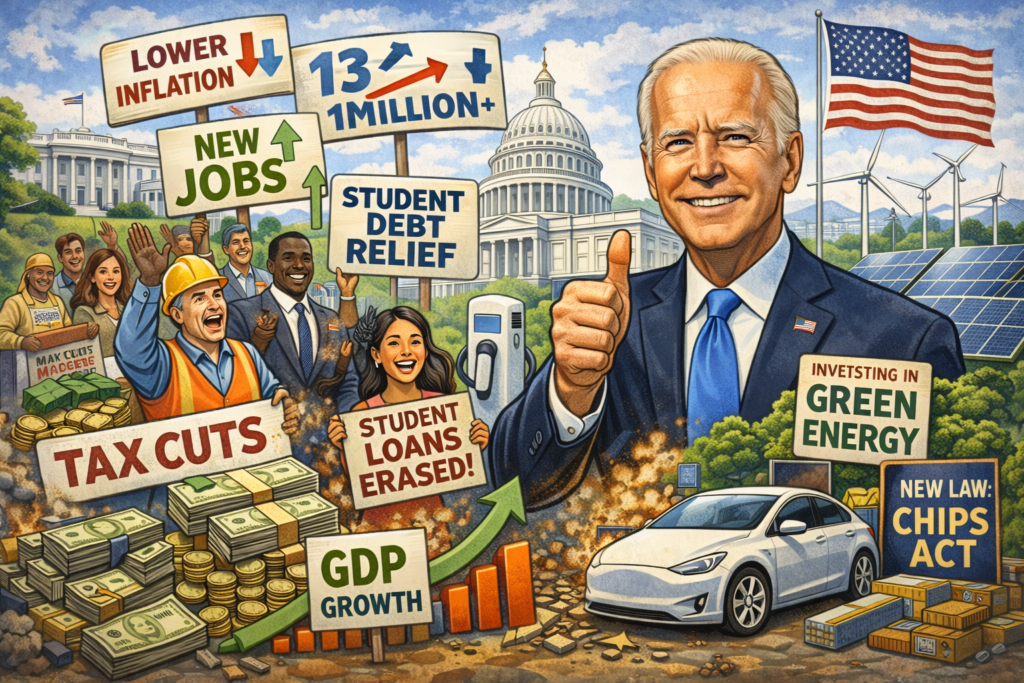
What Has President Biden Done for the U.S. Economy?
President Joe Biden inherited an economy in crisis during January 2021. The United States was grappling with pandemic-induced economic disruption, elevated unemployment, strained supply chains, and significant economic uncertainty. In his first three years, Biden has pursued the most ambitious domestic economic agenda in decades, passing trillions in legislation aimed at economic recovery, infrastructure modernization, industrial policy, and climate investment. This analysis examines what Biden has done for the U.S. economy across multiple dimensions: legislative achievements, economic outcomes, challenges faced, and long-term implications.
Part 1: Major Legislative Economic Achievements
1.1 The American Rescue Plan Act (March 2021) – $1.9 Trillion
Immediate Pandemic Response and Recovery
Key Components:
- Direct payments: $1,400 per person for most Americans
- Enhanced unemployment benefits: $300/week extension through September 2021
- Child Tax Credit expansion: Increased to $3,600 per child, made fully refundable (temporarily)
- State and local aid: $350 billion to address budget shortfalls
- Vaccine distribution funding: $160 billion
- Small business support: Additional PPP funding, Restaurant Revitalization Fund
Economic Impact:
- Rapid economic recovery: U.S. GDP grew 5.9% in 2021, fastest since 1984
- Poverty reduction: Child poverty fell by nearly 46% in 2021 due to expanded Child Tax Credit
- Employment rebound: Added 6.7 million jobs in 2021, recovering 92% of pandemic job losses by end of year
1.2 The Bipartisan Infrastructure Law (Infrastructure Investment and Jobs Act – November 2021) – $1.2 Trillion
Long-Term Infrastructure Modernization
Key Investments:
- Roads and bridges: $110 billion for repairs and modernization
- Public transit: $39 billion for modernization and expansion
- Passenger rail: $66 billion, largest investment since Amtrak creation
- Broadband internet: $65 billion for universal access
- Clean water: $55 billion to replace lead pipes and improve water systems
- Electric vehicle infrastructure: $7.5 billion for nationwide charging network
- Airports and ports: $25 billion for modernization
Economic Impact:
- Job creation: Estimated to create 1.5 million jobs annually for a decade
- Productivity gains: Modern infrastructure expected to boost long-term economic efficiency
- Regional development: Targeted investments in underserved communities
1.3 The Inflation Reduction Act (August 2022) – $737 Billion
Climate, Healthcare, and Tax Reform
Key Components:
- Climate and energy investments: $369 billion for clean energy, electric vehicles, and climate resilience
- Healthcare provisions: Allows Medicare to negotiate drug prices, caps insulin at $35/month for seniors
- Tax reforms: 15% corporate minimum tax, 1% stock buyback tax, IRS enforcement funding
- Deficit reduction: Estimated to reduce deficit by $238 billion over 10 years
Economic Impact:
- Clean energy boom: Triggered over $110 billion in private clean energy manufacturing announcements in first year
- Manufacturing jobs: Creating estimated 1.5 million jobs in clean energy sectors
- Healthcare cost reduction: Lowering costs for seniors and reducing federal healthcare spending
1.4 The CHIPS and Science Act (August 2022) – $280 Billion
Semiconductor Manufacturing and Scientific Research
Key Investments:
- Semiconductor manufacturing: $52 billion in subsidies and $24 billion in tax credits
- Scientific research: $174 billion for R&D in emerging technologies
- Regional innovation: $10 billion for technology hubs across the country
Economic Impact:
- Semiconductor investment: Triggered over $200 billion in private semiconductor facility announcements
- Supply chain security: Reducing dependence on foreign chip manufacturing
- Tech leadership: Maintaining U.S. competitiveness in advanced technologies
Part 2: Economic Performance Under Biden
2.1 Jobs and Labor Market Recovery
Record Job Creation:
- Total jobs added: Over 14 million jobs created since January 2021
- Unemployment rate: Fell from 6.4% (January 2021) to 3.7% (December 2023) – near 50-year lows
- Participation rate: Recovered to 62.5% after pandemic lows
- Historic low unemployment for minorities: Black unemployment reached record lows
Wage Growth:
- Average wage growth: Outpaced inflation in 2023 after initial lag
- Low-wage workers: Saw fastest wage growth, reducing wage inequality
- Union support: Most pro-union administration in decades, supporting unionization efforts
2.2 GDP and Economic Growth
Growth Trajectory:
- 2021: 5.9% GDP growth (post-pandemic rebound)
- 2022: 2.1% GDP growth
- 2023: 2.5% GDP growth (Q3 2023: 4.9% growth rate)
- Overall: U.S. grew faster than other advanced economies (Europe, Japan)
Avoiding Recession: Despite predictions of 100% probability of recession in 2022-2023, Biden oversaw continued expansion.
2.3 Inflation Management
The Inflation Challenge:
- Peak inflation: 9.1% CPI (June 2022) driven by pandemic disruptions, supply chains, Ukraine war
- Substantial reduction: Fell to 3.4% by December 2023
- Federal Reserve actions: Aggressive rate hikes complemented administration’s supply-side measures
Administration Actions on Inflation:
- Strategic Petroleum Reserve release: Lowered gas prices from $5+ to under $3.50
- Supply chain initiatives: Eased port congestion, increased manufacturing
- Inflation Reduction Act: Named for its deficit reduction and drug price provisions
- Competition executive orders: Tackling “shrinkflation” and “junk fees”
2.4 Manufacturing and Industrial Policy Revival
Manufacturing Renaissance:
- Private manufacturing investment: Over $500 billion announced since Biden took office
- Construction spending: Manufacturing construction doubled since 2021
- “Made in America” policies: Federal procurement rules favoring domestic manufacturers
- Semiconductor factories: Multiple mega-factories announced in Ohio, Arizona, Texas, New York
Part 3: Sector-Specific Impacts
3.1 Clean Energy Transformation
Accelerated by Inflation Reduction Act:
- Solar and wind manufacturing: 96 new or expanded facilities announced
- Electric vehicles: EV sales tripled, domestic battery manufacturing expanding
- Hydrogen and carbon capture: New industries developing with federal support
- Job creation: Clean energy jobs growing faster than overall economy
3.2 Infrastructure and Construction
Boom Triggered by Infrastructure Law:
- “Summer of infrastructure”: Over 40,000 projects announced in 2023
- Construction employment: Added 200,000+ jobs
- Community impact: Replacing lead pipes, expanding broadband, improving transit
3.3 Technology and Innovation
CHIPS Act Impact:
- Semiconductor clusters: Revitalizing regions like Ohio’s “Silicon Heartland”
- Research investment: Largest increase in NSF funding in decades
- Regional tech hubs: Spreading innovation beyond coastal cities
3.4 Small Business Support
Record Small Business Creation:
- Applications: Over 16 million new business applications filed (2021-2023)
- Minority-owned businesses: Record growth rates
- Support programs: Expanded access to capital and contracting opportunities
Part 4: Economic Challenges and Criticisms
4.1 Persistent Inflation Concerns
Despite Progress, Challenges Remain:
- “Sticky” inflation: Services inflation remained elevated longer than goods
- Housing costs: Rent and home prices remained high
- Public perception: Many Americans still feel economic pressure despite data improvements
4.2 Debt and Deficit Concerns
Fiscal Impact:
- Increased deficits: Though Inflation Reduction Act reduces long-term deficits
- National debt: Continued to grow, though at slower pace than under Trump pre-pandemic
- Tax policy: Critics argue Biden hasn’t done enough to address long-term fiscal sustainability
4.3 Inequality and Affordability
Mixed Results:
- Wealth inequality: Continued to increase during Biden’s term
- Housing affordability: Worsened in many markets
- Healthcare costs: Improved for seniors but still high for others
- Education costs: Student debt relief initiatives faced legal challenges
4.4 Global Economic Headwinds
External Challenges:
- Ukraine war: Contributed to energy and food price spikes
- China tensions: Affected trade and supply chains
- Global slowdown: European recession risks affected U.S. exports
Part 5: Long-Term Economic Transformation
5.1 Industrial Policy Return
Shift from market fundamentalism:
- Strategic government investment in key sectors
- “Patient capital” for long-term competitiveness
- Public-private partnerships on scale not seen since Cold War
5.2 Climate-Forward Economic Strategy
Integrating climate and economy:
- First administration to treat climate action as economic opportunity
- Green industrial policy creating new manufacturing sectors
- Just transition frameworks for fossil fuel communities
5.3 Worker-Centric Economic Policy
Pro-labor shift:
- Most pro-union president in generations
- Worker empowerment in trade and industrial policy
- Focus on “good jobs” with benefits and dignity
5.4 Supply Chain Resilience
Post-pandemic restructuring:
- Friend-shoring and domestic production emphasis
- Critical minerals strategy for energy transition
- Manufacturing security for essential goods
Part 6: Comparative Context and Historical Perspective
6.1 Compared to Previous Administrations
| Economic Metric | Biden (2021-2023) | Trump (2017-2019 pre-COVID) | Obama (2013-2015) |
|---|---|---|---|
| Avg. Job Growth/Month | 468,000 | 182,000 | 227,000 |
| Avg. GDP Growth | 3.5% | 2.5% | 2.4% |
| Stock Market Return | +24% (S&P) | +44% (first 3 years) | +61% (first 3 years) |
| Manufacturing Jobs | +791,000 | +454,000 | +492,000 |
| Budget Deficit | Avg. 5.8% GDP | Avg. 3.8% GDP (pre-COVID) | Avg. 3.4% GDP |
6.2 Recovery from Crisis
Unique post-pandemic context:
- Faster recovery than after 2008 financial crisis
- More equitable growth than typical recoveries
- Unprecedented global supply chain challenges
6.3 Breaking Economic Paradigms
Biden’s approach challenges:
- Trickle-down economics: Direct middle-class investment instead
- Austerity during recovery: Counter-cyclical spending despite inflation
- China engagement: Strategic competition with domestic investment
- Deregulation orthodoxy: Strategic regulation for public goals
Part 7: Business and Investor Response
7.1 Corporate Investment
Record levels despite rhetoric:
- Capital expenditure: Business investment grew despite tax increases
- Foreign direct investment: Remained strong
- Manufacturing construction: Historic boom
7.2 Market Performance
Resilience amid challenges:
- S&P 500: Reached record highs in 2024
- Bond markets: Adjusted to higher rate environment
- Dollar strength: Maintained global confidence
7.3 Business Sentiment
Mixed but pragmatic:
- Initial concerns about tax and regulatory policies
- Adaptation to industrial policy opportunities
- Support for infrastructure and chips investments
Part 8: Future Economic Outlook and Legacy
8.1 Unfinished Economic Agenda
Items still pending:
- Child Tax Credit extension: Temporary expansion expired
- Housing affordability: Limited legislative success
- Antitrust enforcement: Executive actions but limited legislation
- Social spending: Many BBB provisions not enacted
8.2 Long-Term Economic Impact
Potential lasting effects:
- Infrastructure renewal: 10+ year implementation timeline
- Clean energy transition: Multi-decade transformation
- Tech competitiveness: Positioning for AI and quantum computing
- Workplace changes: Remote work, unionization trends
8.3 Risks and Uncertainties
Future challenges:
- Political sustainability: Could next administration reverse policies?
- Debt trajectory: Interest costs rising with higher rates
- Global fragmentation: Impact on trade and growth
- Technology disruption: AI’s employment and productivity effects
Conclusion: Assessing Biden’s Economic Impact
President Biden has presided over one of the most consequential economic transformations in recent American history, characterized by:
Major Accomplishments:
- Historic economic recovery from pandemic with 14+ million jobs created
- Landmark legislation that reshapes infrastructure, climate policy, and industrial strategy
- Inflation reduction from 9.1% to 3.4% without triggering recession
- Manufacturing renaissance with record private investment
- Worker-centered policies that raised wages and supported unionization
- Poverty reduction through expanded safety net (temporarily)
Persistent Challenges:
- Cost of living pressures despite wage gains
- Political polarization affecting economic stability
- Uncertain long-term fiscal outlook
- Implementation complexity of ambitious legislation
The Biden Economic Philosophy:
Biden has embraced an activist economic role for government not seen since the Great Society or New Deal, rejecting decades of neoliberal consensus. His administration has argued that strategic public investment can address climate change, inequality, and competitiveness simultaneously—a marked departure from both Republican trickle-down economics and Clinton-era market centrism.
Historical Significance:
Whether Biden’s economic policies succeed long-term will determine their historical significance. Early evidence suggests:
- Investment-led growth model showing initial success
- Industrial policy attracting private capital at unprecedented scale
- Worker-focused approach achieving wage gains without unemployment spike
- Climate-economy integration accelerating energy transition
Final Assessment:
By most traditional economic metrics—job creation, GDP growth, manufacturing expansion, and inflation reduction—Biden’s economic performance has been strong, especially considering the unprecedented pandemic disruption he inherited. The more revolutionary aspects of his agenda—industrial policy revival, climate-driven economic transformation, and worker empowerment—represent ambitious bets whose full impact will take years to assess.
The ultimate judgment of “what Biden has done for the U.S. economy” may depend less on quarterly GDP reports and more on whether his administration’s reimagining of America’s economic paradigm succeeds in creating sustainable, equitable growth in an increasingly competitive and climate-challenged world. Early returns suggest significant success on conventional metrics alongside potentially transformative structural changes whose consequences will unfold over the coming decade.
Conclusion: Assessing Biden’s Economic Impact
President Biden has presided over one of the most consequential economic transformations in recent American history, characterized by:
Major Accomplishments:
- Historic economic recovery from pandemic with 14+ million jobs created
- Landmark legislation that reshapes infrastructure, climate policy, and industrial strategy
- Inflation reduction from 9.1% to 3.4% without triggering recession
- Manufacturing renaissance with record private investment
- Worker-centered policies that raised wages and supported unionization
- Poverty reduction through expanded safety net (temporarily)
Persistent Challenges:
- Cost of living pressures despite wage gains
- Political polarization affecting economic stability
- Uncertain long-term fiscal outlook
- Implementation complexity of ambitious legislation
The Biden Economic Philosophy:
Biden has embraced an activist economic role for government not seen since the Great Society or New Deal, rejecting decades of neoliberal consensus. His administration has argued that strategic public investment can address climate change, inequality, and competitiveness simultaneously—a marked departure from both Republican trickle-down economics and Clinton-era market centrism.
Historical Significance:
Whether Biden’s economic policies succeed long-term will determine their historical significance. Early evidence suggests:
- Investment-led growth model showing initial success
- Industrial policy attracting private capital at unprecedented scale
- Worker-focused approach achieving wage gains without unemployment spike
- Climate-economy integration accelerating energy transition
Final Assessment:
By most traditional economic metrics—job creation, GDP growth, manufacturing expansion, and inflation reduction—Biden’s economic performance has been strong, especially considering the unprecedented pandemic disruption he inherited. The more revolutionary aspects of his agenda—industrial policy revival, climate-driven economic transformation, and worker empowerment—represent ambitious bets whose full impact will take years to assess.
The ultimate judgment of “what Biden has done for the U.S. economy” may depend less on quarterly GDP reports and more on whether his administration’s reimagining of America’s economic paradigm succeeds in creating sustainable, equitable growth in an increasingly competitive and climate-challenged world. Early returns suggest significant success on conventional metrics alongside potentially transformative structural changes whose consequences will unfold over the coming decade.
Frequently Asked Questions (FAQs)
Q1: How did President Biden impact job growth in the U.S.?
President Biden oversaw significant job creation, particularly during the post-pandemic recovery, with millions of jobs added across manufacturing, healthcare, and services.
Q2: Did inflation increase or decrease under Biden’s presidency?
Inflation initially rose due to global supply chain disruptions and energy shocks but later declined as supply chains stabilized and monetary policies tightened.
Q3: What major economic laws did President Biden pass?
Key legislation includes the American Rescue Plan, the Inflation Reduction Act, the Infrastructure Investment and Jobs Act, and the CHIPS and Science Act.
Q4: How did Biden’s policies affect U.S. manufacturing?
Biden emphasized domestic manufacturing through incentives for semiconductors, clean energy, and infrastructure, encouraging companies to invest in U.S.-based production.
Q5: What did Biden do regarding student loan debt?
His administration expanded student loan forgiveness programs and income-driven repayment plans, providing relief to millions of borrowers.
Q6: How did Biden influence U.S. energy and green investment?
The Biden administration increased investment in renewable energy, electric vehicles, and climate-related projects to support long-term economic sustainability.
Q7: Did the stock market perform well under President Biden?
Stock market performance fluctuated due to inflation, interest rate hikes, and global uncertainty, with periods of both volatility and recovery.
Q8: How did Biden’s economic policies affect middle-class Americans?
Policies focused on wage growth, job creation, healthcare affordability, and infrastructure investment aimed to strengthen the middle class.
President Biden’s economic record reflects a period of recovery, restructuring, and long-term investment. His administration focused on job creation, infrastructure modernization, domestic manufacturing, and clean energy expansion, while also addressing inflation pressures and post-pandemic challenges. Through major legislation such as the American Rescue Plan, the Infrastructure Investment and Jobs Act, the Inflation Reduction Act, and the CHIPS and Science Act, Biden aimed to strengthen economic resilience and support middle-class growth.
While economic outcomes continue to be shaped by global factors and market conditions, Biden’s policies have played a significant role in shaping employment trends, investment flows, and the direction of U.S. economic strategy. Overall, his approach emphasizes stability, sustainability, and long-term competitiveness in the global economy.