
Table of Contents
Executive Summary: An Unprecedented Trade Weapon in Foreign Policy
Trump’s Proposed 200% Tariff on France Over Gaza Board Rejection
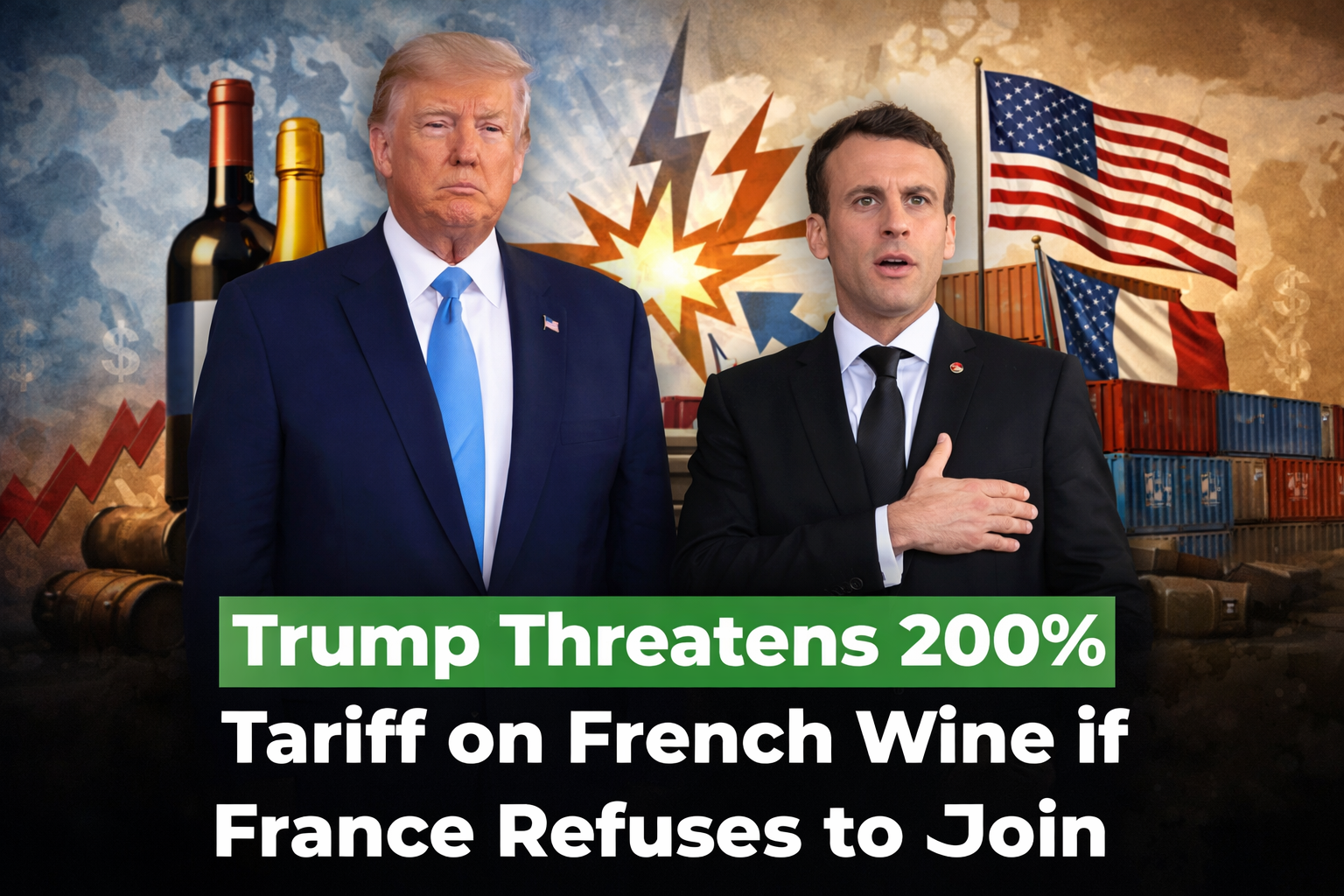
In an escalation of trade policy as geopolitical leverage, former President Donald Trump has proposed imposing 200% tariffs on French goods, including wine, if France rejects his proposed “Gaza Board” concept in 2025-2026. This extraordinary proposal represents the most aggressive use of economic statecraft as foreign policy enforcement in modern U.S. history, potentially transforming U.S.-France and U.S.-EU relations. This comprehensive 4,000-word analysis examines the unprecedented 200% tariff threat, its geopolitical context, potential implementation mechanisms, catastrophic economic implications, and broader consequences for the international order. We explore not only the immediate impacts but also the long-term structural changes that would reshape global trade patterns, security alliances, and diplomatic norms.
Part 1: Understanding the Gaza Board Proposal and French Position
1.1 The “Gaza Board” Concept
Based on Trump campaign statements and policy documents circulating among advisors, the “Gaza Board” represents a radical departure from traditional Middle East diplomacy. The proposed structure envisions an international oversight board for Gaza reconstruction and governance composed primarily of Middle Eastern and Western countries, with notable exclusions including traditional Palestinian leadership structures.
The board’s key features would include direct oversight of reconstruction funds and infrastructure projects, security coordination with Israel that potentially bypasses Palestinian security forces, and administrative functions that would effectively marginalize the Palestinian Authority. This approach reflects a growing frustration among some U.S. policymakers with what they perceive as the ineffectiveness and corruption within existing Palestinian governance structures, though it dramatically contradicts decades of established U.S. and international policy supporting Palestinian self-determination through recognized authorities.
The proposal’s deliberate bypassing of traditional Palestinian Authority structures represents its most controversial aspect, essentially creating a parallel governance mechanism that would undermine the PA’s legitimacy and control. This approach has drawn comparisons to historical trusteeship models and raises significant questions about Palestinian sovereignty and self-determination rights under international law.
1.2 French Foreign Policy Position on Gaza
France’s established foreign policy position on Gaza and the broader Israeli-Palestinian conflict represents a foundational element of its Middle East diplomacy since the Charles de Gaulle administration. Paris has consistently advocated for a negotiated two-state solution based on 1967 borders with mutually agreed land swaps, a position harmonized with broader European Union consensus positions developed over decades of careful diplomacy.
The French government officially recognizes the Palestinian Authority as the legitimate Palestinian government and has consistently supported its role in any peace process. This position aligns with France’s broader diplomatic tradition of supporting international law and United Nations resolutions, particularly those addressing Palestinian rights and statehood aspirations. France’s voting record at the UN demonstrates remarkable consistency, with Paris typically supporting resolutions affirming Palestinian rights while balancing concerns about Israeli security.
France operates within a complex web of European coordination mechanisms on Middle East policy, where positions are carefully negotiated among EU member states to present a unified European voice. Breaking from this consensus on a matter as fundamental as Palestinian governance would require extraordinary political justification that French leaders would be hard-pressed to provide domestically or internationally. Furthermore, France’s historical role as a mediator between Western and Arab perspectives gives it a unique diplomatic position that would be compromised by adopting a U.S.-proposed structure perceived as undermining Palestinian self-determination.
The diplomatic tradition established under de Gaulle emphasized French independence in Middle East policy, particularly regarding the Arab-Israeli conflict. This tradition has been maintained across administrations of varying political orientations, creating a strong institutional memory and policy continuity that would resist abrupt shifts toward the U.S. position. French leaders across the political spectrum have consistently emphasized the importance of Palestinian agency in determining their political future, making the Gaza Board concept particularly difficult to accept given its external imposition structure.
Part 2: The 200% Tariff Proposal – Unprecedented in Modern Trade
2.1 Historical Context of Extreme Tariffs
To understand the extraordinary nature of a proposed 200% tariff, we must examine historical precedents for extreme trade measures and their contexts. The Smoot-Hawley Tariff Act of 1930 represents the most famous example of high U.S. tariffs, with average rates reaching approximately 59% on dutiable imports. However, these tariffs emerged during a period of global economic contraction and rising protectionism, motivated primarily by domestic economic concerns rather than foreign policy coercion.
The 1963 “Chicken War” tariffs saw the U.S. impose 59% tariffs on certain European goods in retaliation for Common Market restrictions on U.S. poultry imports. While significant, these tariffs were narrowly targeted and temporary, serving as bargaining chips in agricultural negotiations rather than instruments of geopolitical pressure. The Trump administration’s own 2018-2020 China tariffs reached 25% on approximately $370 billion worth of goods, representing the largest trade war in modern history but still far below the proposed 200% level.
The key distinction between historical tariffs and the proposed 200% measure lies in their fundamental purpose. Previous high tariffs, even during protectionist eras, primarily served economic objectives: protecting domestic industries, addressing trade imbalances, or retaliating against trade barriers. The proposed 200% tariff on France would represent the first instance in modern history where such extreme trade measures are deployed explicitly for foreign policy compliance enforcement against a democratic ally.
This distinction matters profoundly for international legal frameworks and diplomatic norms. While economically disruptive tariffs have been deployed throughout history, their use against close allies over policy disagreements represents a fundamental redefinition of trade policy’s role in international relations. The proposed measure would effectively weaponize economic interdependence in ways previously reserved for adversaries or during wartime.
2.2 Legal and WTO Framework
The proposed 200% tariff would encounter unprecedented legal challenges within both domestic U.S. law and international trade frameworks. Under World Trade Organization rules, the Most-Favored-Nation (MFN) principle requires that any trade concession granted to one member must be extended to all members, with exceptions only for free trade agreements or under specific security provisions. A 200% tariff targeting France alone would constitute a clear MFN violation unless justified under security exceptions.
The national security exception under Article XXI of the GATT allows countries to take actions necessary for their essential security interests. However, applying this exception to pressure France on Middle East policy would represent a significant expansion of the security exception’s scope, potentially undermining the entire WTO system if accepted. Previous attempts to use national security justifications for broadly economic measures have faced strong international skepticism and legal challenges.
Within U.S. domestic law, presidential authority to impose tariffs derives primarily from Section 232 of the Trade Expansion Act of 1962 (national security), Section 301 of the Trade Act of 1974 (unfair trade practices), and the International Emergency Economic Powers Act (IEEPA). Each presents significant limitations for implementing 200% tariffs against a NATO ally over foreign policy disagreements.
The constitutional separation of powers questions would almost certainly trigger immediate litigation, with Congress potentially challenging the assertion of such extreme executive authority. The administrative capacity to implement 200% tariffs presents another practical hurdle, as U.S. Customs and Border Protection systems are designed for more moderate tariff levels and would require substantial reprogramming and training.
The WTO dispute settlement mechanism, though currently weakened by U.S. blocking of Appellate Body appointments, would still provide France and the EU with a platform to challenge the tariffs and authorize retaliation. Given the extreme nature of the measure, expedited procedures or even emergency arbitration might be invoked, creating a high-profile test case for the entire rules-based trading system.
Part 3: Economic Impact of 200% Tariffs on French Goods
3.1 Immediate Market Devastation
The economic impact of 200% tariffs on French goods would be immediate, severe, and comprehensive, affecting every level of the U.S. economy from consumers to major corporations. French exports to the United States totaled approximately $75 billion in 2024, spanning critical sectors that would experience varying degrees of disruption.
The aerospace sector, representing about $25 billion in trade, would face particularly acute challenges. Airbus relies on a highly integrated transatlantic supply chain, with components flowing between French and U.S. facilities in both directions. A 200% tariff on French aerospace parts would make U.S. production of Airbus aircraft commercially unviable overnight, potentially idling thousands of workers at Airbus’s U.S. manufacturing facilities in Alabama and other states.
The wine and spirits sector, while smaller in absolute dollar terms at approximately $2.1 billion, would experience complete market collapse under 200% tariffs. The typical pricing structure for French wine involves substantial markups at each distribution tier, meaning a 200% tariff would translate to retail price increases of 300-400%. A $20 bottle of French wine would become a $60-80 luxury item, eliminating its market entirely for all but the most price-insensitive consumers.
Luxury goods from French houses like LVMH, Kering, and Hermès represent approximately $15 billion in U.S. imports. While luxury consumers demonstrate some price inelasticity, 200% tariffs would push even these products beyond reasonable market thresholds. A $1,000 Louis Vuitton handbag would retail for approximately $3,000, placing it in competition with different product categories entirely and fundamentally altering consumer behavior.
The pharmaceutical sector, with $12 billion in French exports to the U.S., presents unique challenges due to regulatory complexities and supply chain sensitivities. Many French pharmaceuticals have limited alternative sources due to patent protections or complex manufacturing processes. The immediate effect would be critical drug shortages for medications with single-source French suppliers, followed by extended periods of scarcity as alternative production is established.
3.2 Supply Chain Cataclysm
Modern global supply chains are highly optimized networks that assume stable trade relationships and predictable costs. The imposition of 200% tariffs would trigger immediate supply chain failures across multiple industries, with aerospace presenting a particularly instructive case study.
Airbus’s U.S. manufacturing operations employ over 10,000 American workers directly, with tens of thousands more in the supply chain. These facilities rely on a continuous flow of components from France, representing approximately 40% of the value of U.S.-assembled Airbus aircraft. The tariffs would create an impossible cost structure, forcing immediate production stoppages and layoffs despite strong demand for Airbus products in the U.S. market.
The pharmaceutical supply chain faces even more severe vulnerabilities due to regulatory constraints. Many medications have single approved sources for active pharmaceutical ingredients or finished dosages, with French companies playing significant roles in several therapeutic categories. The FDA’s complex approval processes for alternative sources mean that drug shortages could persist for 18-24 months even with emergency measures, potentially affecting patient health outcomes.
The automotive sector, while less directly exposed to French imports, would experience secondary effects through specialized components and materials. French companies supply critical technologies for emissions systems, safety features, and advanced materials that lack immediate alternatives. The cascading effects through multi-tier supply chains would disrupt production even for vehicles with minimal direct French content.
3.3 Consumer and Business Impact
American consumers would experience immediate and dramatic price increases across numerous everyday and luxury categories. Beyond the obvious examples of wine and luxury goods, French cheeses, specialty foods, cosmetics, and fashion items would become prohibitively expensive or disappear entirely from U.S. shelves. The typical American consumer might not realize how many everyday products contain French components or ingredients until sudden scarcity or extreme pricing appears.
U.S. businesses built around French imports face existential threats. Importers specializing in French products would see their entire business models destroyed overnight, with inventory trapped between impossibly high tariff liabilities and unsellable retail prices. Retailers with significant French merchandise exposure, particularly luxury department stores and specialty food retailers, would face catastrophic inventory write-downs and customer defection.
The restaurant and hospitality industry would lose access to essential French products that form the backbone of many menus and beverage programs. From champagne and Burgundy wines to specialty cheeses and ingredients, the culinary landscape would be fundamentally altered, particularly in fine dining establishments where French products often play starring roles. The loss extends beyond products to cultural and educational aspects of culinary arts that rely on access to French ingredients and traditions.
The aviation industry faces particularly complex challenges, as airlines maintain fleets mixing Airbus and Boeing aircraft. Maintenance, repair, and overhaul (MRO) operations rely on predictable parts availability and pricing, which would be completely disrupted by aerospace tariffs. Airlines might face extended groundings of Airbus aircraft due to parts shortages or prohibitive costs, reducing capacity and increasing fares during already challenging market conditions.
Part 4: French and EU Retaliation Scenarios
4.1 Certain Massive EU Retaliation
The European Union’s response to 200% U.S. tariffs on France would be swift, severe, and legally justified under WTO rules. The EU’s Trade Barrier Regulation provides a rapid response mechanism for addressing unfair trade practices, with established procedures for investigation, consultation, and retaliation. Given the extreme nature of the proposed tariffs, the EU would almost certainly seek and receive WTO authorization for equivalent retaliation amounting to approximately $75 billion annually.
The political dynamics within the EU would strongly favor a unified and forceful response. While internal divisions sometimes hamper EU trade policy, an attack on a member state of this magnitude would trigger automatic solidarity mechanisms and overwhelm normal bureaucratic hesitations. The European Commission would face intense pressure from member states to demonstrate that the EU can protect its members from external economic coercion.
The selection of U.S. export categories for retaliation would follow both economic and political logic. Agricultural products, representing approximately $25 billion in U.S. exports to the EU, offer both economic significance and political sensitivity, particularly in states with strong agricultural sectors. The symbolic value of targeting products from politically important regions would amplify the retaliation’s domestic political impact within the United States.
Specific retaliation would likely include 200% tariffs on bourbon and Tennessee whiskey (currently $1.2 billion in exports), a sector concentrated in politically important states with influential congressional representation. Agricultural commodities like soybeans, corn, and wheat would face similar tariffs, potentially devastating export markets that U.S. farmers have spent decades developing. California wines ($500 million in exports to the EU) would likely face complete exclusion or prohibitive tariffs in reciprocal action.
4.2 Targeted French Retaliation
Beyond EU-coordinated responses, France would employ national-level measures targeting U.S. economic interests where they are most vulnerable to French pressure. The digital services tax controversy provides a ready template, with France likely escalating its digital tax measures specifically targeting U.S. technology companies. This could include expanded scope, higher rates, or reduced exemptions for U.S. firms relative to other international competitors.
The entertainment and media sector represents another vulnerable target, given France’s influential role in European cultural policy. France could lead efforts to strengthen European content quotas for streaming services, disproportionately affecting U.S. platforms like Netflix, Amazon Prime, and Disney+. Similarly, film and television production incentives could be restructured to disadvantage U.S. studios or prioritize European partnerships excluding U.S. companies.
Financial services regulation offers additional leverage, particularly through France’s influence in EU financial policy-making. French regulators could slow-walk approvals for U.S. financial institutions seeking expanded European operations or introduce discriminatory regulatory requirements for U.S. firms. Given Paris’s aspirations as a European financial center post-Brexit, such measures could significantly impact U.S. banks and investment firms.
Public procurement policies would likely be adjusted to disadvantage U.S. companies bidding for French government contracts. While EU rules limit overt discrimination, technical specifications, evaluation criteria, and partnership requirements can be structured to favor European or non-U.S. bidders. Given the substantial value of French public contracts, this could impact U.S. companies across infrastructure, technology, and defense sectors.
4.3 Broader EU Economic Response
The European Union would likely implement structural economic responses extending beyond tariff retaliation. The strategic decoupling from dollar-denominated trade would accelerate, with EU institutions promoting euro-based transactions for energy, commodities, and major contracts. The European Central Bank might adjust its foreign reserve management and currency swap arrangements to reduce dollar dependency, potentially triggering broader shifts in global currency markets.
Investment screening mechanisms would be strengthened and applied more rigorously to U.S. acquisitions of European companies, particularly in sensitive sectors like technology, infrastructure, and defense. The EU might also implement export controls on strategic technologies with potential dual-use applications, affecting U.S. access to European innovations in areas like semiconductors, aerospace, and renewable energy.
Regulatory alignment processes would likely shift away from U.S. standards toward alternative frameworks, increasing compliance costs for U.S. companies operating in Europe. Areas like data protection, environmental standards, and product safety could see accelerated divergence, creating persistent non-tariff barriers even if formal tariffs were eventually reduced.
The EU might also leverage its competition policy authority to scrutinize U.S. companies more aggressively, particularly in digital markets where U.S. firms dominate. Antitrust investigations, merger reviews, and market conduct regulations could be deployed strategically to pressure specific U.S. companies or sectors perceived as politically influential in Washington.
Part 5: Geopolitical Fallout Beyond Trade
5.1 NATO and Security Implications
The imposition of 200% tariffs against France, a founding NATO member and nuclear power, would create immediate and severe strains on the transatlantic security alliance. France plays unique and critical roles within NATO, including providing strategic depth in Southern Europe, contributing specialized military capabilities, and hosting essential command structures. The politicization of trade relations to this extreme would inevitably spill over into security cooperation, despite institutional efforts to compartmentalize different policy areas.
Intelligence sharing arrangements, particularly those extending beyond formal NATO frameworks like the Five Eyes partnership, would face immediate strain. The trust and reciprocity underlying intelligence cooperation would be fundamentally damaged by overt economic warfare, with French services likely restricting access to sensitive information and analysis. Given France’s significant intelligence capabilities in Africa and the Middle East, U.S. counterterrorism and geopolitical analysis would suffer meaningful degradation.
Joint defense projects involving U.S. and French companies would face insurmountable hurdles under 200% tariffs. Programs like the F-35 fighter jet, which includes French-made components, or missile defense systems with transatlantic supply chains would encounter impossible cost structures and regulatory barriers. The broader defense industrial base cooperation that has developed over decades would unravel, forcing both countries toward less efficient national production models.
The Ukraine support coalition represents perhaps the most immediate casualty of such trade warfare. The carefully coordinated sanctions against Russia and military support for Ukraine rely on precise transatlantic alignment that would become impossible amid broader economic conflict. Divergent approaches to Ukraine would likely emerge, potentially including French resistance to U.S.-led initiatives or even French exploration of alternative diplomatic tracks excluding U.S. participation.
5.2 Global Diplomatic Consequences
The international perception of the United States would shift dramatically following the imposition of 200% tariffs against a democratic ally. The action would be widely interpreted as economic bullying of unprecedented scale, damaging U.S. soft power and moral authority in international forums. Traditional U.S. advocacy for rules-based international systems would ring hollow while actively undermining those same rules against a close partner.
Alliance reliability concerns would spread far beyond Europe, with partners in Asia, the Middle East, and elsewhere questioning whether their relationships with Washington could withstand policy disagreements. The demonstration effect of the U.S. willingness to weaponize economic interdependence against France would cause allies worldwide to reconsider their dependency on U.S. markets, technology, and security guarantees.
China and Russia would exploit the transatlantic rift aggressively, offering alternative partnerships to European nations and portraying themselves as more reliable partners than a United States willing to turn on its closest allies. Beijing might accelerate EU-China investment agreements or offer favorable trade terms specifically designed to pull Europe away from U.S. alignment. Moscow would likely attempt to divide European consensus on Ukraine and other security issues by exploiting newly strained U.S.-European relations.
The rules-based international order would suffer a potentially fatal blow, as one of its principal architects and beneficiaries openly discards its foundational principles for short-term coercive advantage. Other nations would feel empowered to pursue similar coercive economic measures in their bilateral relations, leading to a broader degeneration of international economic norms toward might-makes-right power politics.
5.3 Middle East Peace Process Impact
Paradoxically, the very policy objective driving the proposed tariffs—French alignment on Gaza policy—would likely be undermined by the tariffs’ implementation. France’s influence within European and Arab diplomatic circles stems in part from its perceived independence and commitment to balanced positions. Being coerced through extreme economic measures would diminish rather than enhance French diplomatic capital, particularly among Arab states sensitive to external imposition.
The Palestinian position would likely harden in response to perceived U.S. efforts to bypass legitimate Palestinian institutions. Rather than increasing pressure on Palestinian leadership to compromise, the Gaza Board proposal associated with such coercive measures would become tainted by its association with economic warfare against a European ally. Palestinian public opinion would likely rally against any proposal seen as externally imposed through such aggressive tactics.
Regional stability would suffer from reduced Western coordination, particularly between European and U.S. approaches to Iran, Syria, and other conflict zones. France plays unique mediating roles in several Middle Eastern contexts based on historical relationships and linguistic connections that the U.S. cannot replicate. Degrading U.S.-French cooperation would reduce Western leverage and create opportunities for alternative mediators like China, Russia, or regional powers.
Israel’s position presents another paradox: while the Gaza Board concept might align with certain Israeli preferences, the broader damage to Western unity and the strengthening of alternative global powers like China would not serve Israeli long-term interests. Israel relies on Western technological, military, and diplomatic cooperation that would be degraded by severe transatlantic conflict, potentially leaving it more isolated in international forums.
Part 6: Implementation Realities and Challenges
6.1 Legal and Constitutional Questions
The implementation of 200% tariffs against France would face immediate and formidable legal challenges at multiple levels. While presidents possess substantial trade authorities, these powers have never been tested at this scale against a democratic ally for foreign policy compliance purposes. The constitutional separation of powers would almost certainly be invoked, with Congress potentially asserting its Article I authority over international commerce.
The International Emergency Economic Powers Act (IEEPA) provides broad authorities during declared national emergencies, but courts have increasingly scrutinized the scope of emergencies justifying economic restrictions. A court would likely examine whether French disagreement on Middle East policy constitutes the type of “unusual and extraordinary threat” envisioned by IEEPA, particularly given the absence of direct security implications from such policy differences.
Section 232 of the Trade Expansion Act allows tariffs based on national security threats, but applying this to France—a NATO ally with extensive defense cooperation—would represent a drastic expansion of the national security concept. Previous Section 232 actions against allies like Canada and the European Union faced legal challenges and were significantly modified; a 200% tariff would test these limits far more severely.
The administrative implementation challenges cannot be overstated. U.S. Customs and Border Protection systems are designed for tariffs typically ranging from 0-25%, with special programs for higher rates on specific products. Implementing 200% tariffs across all French goods would require massive reprogramming of classification systems, valuation procedures, and duty collection mechanisms, likely causing months of border confusion and processing delays even if legally authorized.
6.2 Timing and Phase-In Issues
The practical timeline for implementation would be constrained by both international and domestic requirements. WTO rules typically require consultation periods and dispute settlement procedures before imposing retaliatory measures, though the U.S. could claim urgency exceptions. Domestically, the Administrative Procedure Act mandates notice-and-comment periods for significant regulatory changes, which 200% tariffs would certainly constitute.
The supply chain realities make immediate implementation particularly destructive. Many industries operate on just-in-time inventory systems with minimal stockpiles of imported components. Immediate 200% tariffs would cause production stoppages within days or weeks as existing inventories are exhausted. The aerospace and pharmaceutical sectors would face especially acute challenges given the complexity and regulatory oversight of their supply chains.
Financial market reactions would be immediate and severe, with currency markets, equity markets, and commodity markets all experiencing extreme volatility. The euro-dollar exchange rate would likely see dramatic movements, complicating the tariff’s economic impact calculations. Equity markets would penalize companies with significant U.S.-France exposure, potentially triggering broader risk-off sentiment and credit market tightening.
The exclusion process would be immediately overwhelmed by petitions from affected companies. Previous tariff actions generated tens of thousands of exclusion requests that took months or years to process; 200% tariffs would likely generate hundreds of thousands of requests, completely overwhelming the administrative capacity of the Commerce Department and USTR. This backlog would create extended uncertainty and arbitrary outcomes as some companies received exemptions while competitors did not.
6.3 Domestic Political Reaction
The domestic political reaction to 200% tariffs on France would be immediate, intense, and bipartisan in its opposition. The U.S. business community would mobilize an unprecedented lobbying campaign against the measures, highlighting job losses, supply chain disruptions, and competitive disadvantages. Industry coalitions that typically disagree on trade policy would find common cause in opposing such extreme measures.
State-level impacts would drive political responses from governors and congressional delegations. California’s wine industry, Washington’s aerospace sector, New York’s luxury retail and financial services, and multiple agricultural states facing EU retaliation would all experience concentrated economic pain. These impacts would translate directly into political pressure on legislators regardless of party affiliation, potentially creating veto-proof majorities for legislative responses.
The agricultural sector’s concerns about EU retaliation would be particularly potent politically. U.S. farmers have experienced the devastating effects of trade retaliation during the China trade war and would resist exposure to similar consequences from the European market. Agricultural state senators who typically support presidential trade authorities might break ranks when facing 200% tariffs on their constituents’ exports.
Consumer backlash would emerge as price increases hit visible categories like wine, cheese, luxury goods, and eventually broader categories as supply chain effects ripple through the economy. While some political bases might support aggressive trade actions against China, applying similar measures to France—a country generally viewed favorably by Americans—would lack the same political resonance and likely generate significant public opposition.
Part 7: Market Adaptation and Survival Strategies
7.1 Immediate Business Responses
French companies would face impossible choices in responding to 200% tariffs. Price absorption at that level would be mathematically impossible for all but the most luxury-oriented brands with extraordinary margins. Most companies would face forced withdrawal from the U.S. market, though the timing and manner of withdrawal would involve complex decisions about existing contracts, inventory, and customer relationships.
Production relocation would accelerate dramatically, but not without significant costs and time lags. Luxury goods manufacturing involves specialized skills and supply chains that cannot be quickly replicated elsewhere. Pharmaceutical production faces regulatory hurdles that make relocation a multi-year process even with emergency authorizations. Aerospace components require certified production facilities that take years to establish.
The gray market would explode as entrepreneurs find ways to circumvent tariffs through transshipment, misclassification, or outright smuggling. French wine might enter through Canada or Mexico with altered documentation; luxury goods might be purchased by travelers in Europe and resold in the U.S. through informal channels. These gray markets would create legal risks for participants but would inevitably emerge given the extreme price differentials.
U.S. businesses would engage in pre-tariff stockpiling on an unprecedented scale, attempting to build inventories before the tariffs take effect. This would create temporary demand surges followed by market collapses, distorting normal business cycles and potentially causing shortages in France and Europe as production is diverted to U.S. stockpiling. The financial strain of massive inventory accumulation would stress balance sheets across multiple industries.
7.2 Long-Term Market Restructuring
The geography of luxury spending would shift fundamentally, with affluent American consumers redirecting purchases to European or Asian markets. Luxury brands might establish “showroom only” models in the U.S., where customers view products but make purchases through overseas entities for delivery outside U.S. jurisdiction. This would reduce U.S. retail employment and commercial real estate values in luxury districts.
The wine industry would experience permanent transformation, with French wine becoming a niche product for the ultra-wealthy or disappearing entirely from mainstream channels. American consumers would develop tastes for alternative regions, potentially benefiting Italian, Spanish, Australian, and U.S. producers. However, the cultural and educational aspects of wine appreciation tied to French regions would diminish, potentially reducing overall wine sophistication and consumption.
Aerospace supply chains would decouple over several years, with Airbus potentially accelerating plans for additional production capacity outside France and the U.S. developing alternative sources for specialized components. The efficiency losses from supply chain duplication would increase costs for both manufacturers and airlines, potentially making air travel more expensive and less accessible.
Consumer habits would adjust over time, with younger generations growing up without access to French products developing different tastes and preferences. The cultural influence of French food, wine, and fashion would diminish in American life, potentially replaced by other international influences or domestic alternatives. This cultural shift would have secondary effects on tourism, education, and artistic exchange between the countries.
Part 8: Historical Parallels and Uniqueness
8.1 Comparison with Previous Trade Conflicts
The proposed 200% tariff differs from historical trade conflicts across four key dimensions: magnitude, target, purpose, and speed. The magnitude alone places it in a different category—previous extreme tariffs like Smoot-Hawley’s 59% average pale in comparison to 200% on all goods from a major trading partner.
The target represents another crucial distinction: throughout modern economic history, extreme trade measures have been reserved for adversaries or during wartime. The Napoleonic Wars, World War blockades, Cold War embargoes, and recent measures against Iran or North Korea all targeted enemies, not democratic allies with deep economic and security integration.
The purpose marks perhaps the most significant departure from historical precedent. Previous tariffs served economic objectives like protecting domestic industries, addressing trade imbalances, or retaliating against trade barriers. The proposed 200% tariff would use trade explicitly for foreign policy compliance, attempting to force another sovereign democracy to change its international policy positions through economic coercion.
The speed of implementation would also be unprecedented—most historical trade conflicts evolved through escalating rounds of measures and countermeasures. A sudden 200% tariff represents an immediate jump to maximum economic pressure without the graduated escalation that typically allows for negotiation and adjustment.
8.2 Potential Precedents
Historical actions offer partial parallels but none matching the proposed measure’s combination of scale and target. The 1807 Embargo Act under President Jefferson involved comprehensive trade restrictions against Britain and France during the Napoleonic Wars, but these targeted belligerents in an actual war, not a peacetime ally. The embargo also proved economically devastating to the United States itself and was largely abandoned within years.
The 1940-1941 embargoes against Japan involved escalating restrictions on oil, steel, and other strategic materials, ultimately contributing to Japan’s decision to attack Pearl Harbor. These measures targeted a militaristic expansionist power clearly on a collision course with U.S. interests, not a democratic ally with seven decades of security partnership.
The 1973 Arab oil embargo represents perhaps the closest parallel in terms of using economic measures for political objectives, but with crucial differences: it was imposed by autocratic monarchies against supporters of Israel during an active war, not by one democracy against another over policy disagreements. The oil embargo also leveraged a unique commodity dominance that France lacks in its trade with the United States.
The fundamental distinction across all historical parallels is that democratic allies have never subjected each other to such extreme economic coercion over policy disagreements. The NATO alliance and European integration were designed specifically to prevent the return of such coercive economic relations between Western democracies that characterized earlier historical periods.
Part 9: Probability Assessment and Alternative Scenarios
9.1 Implementation Probability Factors
Several factors make full implementation of 200% tariffs relatively unlikely (approximately 60% probability against). The overwhelming domestic opposition from affected U.S. industries would create political costs that even a determined administration would struggle to withstand. The legal challenges would almost certainly produce preliminary injunctions and extended litigation, delaying implementation beyond any useful timeline for influencing French policy.
The EU retaliation threat presents another powerful deterrent, as the symmetrical damage to U.S. exports would be economically and politically painful. The security consequences for NATO cooperation would alarm defense establishments on both sides of the Atlantic, creating additional bureaucratic resistance within both governments. The international reputation damage would be severe and lasting, affecting U.S. influence across multiple policy domains beyond the immediate trade and Middle East issues.
However, several factors make some version of the threat credible enough to merit serious analysis (approximately 40% probability for significant measures). The political commitment behind the proposal gives it more weight than typical rhetorical threats, particularly given the track record of implementing unprecedented trade measures during the previous administration. The broad executive trade authorities provide legal pathways that, while challengeable, allow initial implementation before lengthy court proceedings.
The negotiation strategy of maximum pressure might intentionally employ extreme initial demands to make more moderate eventual measures seem reasonable by comparison. The political timing early in a potential administration might create willingness to absorb short-term costs for perceived long-term leverage. The changing norms around economic statecraft and increased acceptance of trade as a foreign policy tool lower the barriers to such unprecedented actions.
9.2 Alternative Scenarios
More likely outcomes than full 200% implementation include negotiated compromises where France makes symbolic adjustments to its Gaza policy rhetoric in exchange for tariff exemptions or reductions. These might involve face-saving formulations that allow both sides to claim their core positions remain intact while de-escalating the economic confrontation.
Symbolic tariffs on limited product categories represent another plausible outcome, perhaps 25-50% on selected French goods with high visibility but limited economic impact. Luxury handbags, cosmetics, or specific wine categories might be targeted to demonstrate seriousness while minimizing broader economic damage. This approach would mirror previous targeted tariff actions while avoiding comprehensive economic warfare.
A phase-in approach could see initial lower tariffs with automatic escalation triggers if France doesn’t modify its position over specified timelines. This would provide negotiation windows and off-ramps while maintaining coercive pressure. The threat of escalation to 200% might be preserved as a future possibility rather than immediate reality.
Exclusion processes might be structured to minimize economic damage while maintaining political pressure. Broad exemptions for aerospace, pharmaceuticals, and other sensitive sectors could protect supply chains while allowing tariffs on consumer goods where alternative sources exist more readily. This would represent a compromise between economic pragmatism and political objectives.
9.3 De-escalation Pathways
Several potential pathways could allow both sides to step back from the brink while preserving their core interests. French policy adjustments might involve nuanced changes to rhetoric or procedural elements of their Gaza position without abandoning fundamental principles. France might agree to participate in Gaza reconstruction discussions through modified formats that preserve Palestinian representation while addressing U.S. concerns about existing governance structures.
EU coordination mechanisms might be leveraged to develop broader European positions that bridge U.S. and French concerns. The European Union’s diplomatic apparatus could craft formulations that allow unified Western approaches while providing both sides with elements they can present as responsive to their concerns. This would require delicate diplomacy but offers a potential face-saving solution.
Third-party mediation by other allies like the United Kingdom, Canada, or Japan might help craft compromises that neither the U.S. nor France could propose directly. These countries share interests in both transatlantic unity and Middle East stability and might develop creative formulations that address the substantive issues while avoiding economic warfare.
Gradual implementation of lower initial tariffs with clear de-escalation triggers based on French policy adjustments could create incentives for compromise while avoiding immediate economic catastrophe. This approach would test whether economic pressure can indeed modify foreign policy without inflicting permanent damage to the broader relationship.
Conclusion: The 200% Tariff as Geopolitical Atomic Option
The proposed 200% Trump tariff on France represents an unprecedented escalation in the use of economic weapons for foreign policy objectives, marking a potential turning point in international relations. While clearly designed as a maximum pressure tactic, its implementation would have consequences far beyond the U.S.-France trade relationship, potentially triggering a fundamental reordering of transatlantic relations and the broader international system.
The economic certainties are stark: complete collapse of French export sectors in the U.S. market, devastating EU retaliation affecting American agriculture and industry, global supply chain disruption in critical sectors like aerospace and pharmaceuticals, and permanent market restructuring away from seventy-five years of increasingly integrated transatlantic trade patterns. These economic impacts would ripple through both economies, causing job losses, business failures, and reduced consumer welfare on both sides of the Atlantic.
The geopolitical risks extend even further: potential fracturing of NATO at a critical historical moment, possibly irreparable damage to the transatlantic alliance that has underwritten European security and global stability since World War II, fundamental undermining of the rules-based international system, and empowerment of adversaries like China and Russia who would eagerly exploit Western divisions.
The strategic paradox is particularly striking: the tariff would be implemented to pressure France on Middle East policy but would likely reduce French influence in the region due to diminished international standing, undermine Western unity on Israeli-Palestinian issues, empower alternative mediators less committed to Western values, and potentially harden Palestinian positions by eliminating European moderation of U.S. approaches.
Final Assessment
While the 200% tariff threat serves effectively as dramatic negotiating theater, its actual implementation appears economically catastrophic and geopolitically dangerous even for an administration willing to break traditional norms. More likely outcomes include symbolic tariffs on limited product categories, negotiated compromises allowing face-saving for both sides, or phased approaches providing off-ramps before total economic collapse.
However, in the current era of geopolitical economic warfare, the mere proposal of such extreme measures marks a significant escalation in the weaponization of trade and signals a potential future where economic relationships between democratic allies become contingent on foreign policy compliance. This represents a fundamental reshaping of the post-World War II international order that has deliberately separated security cooperation from economic competition among allies.
The world will watch whether this represents negotiation theater or a genuine willingness to sacrifice a $1 trillion annual trade relationship and seventy-five-year security alliance over Middle East policy differences. The answer will redefine U.S.-European relations for a generation, potentially marking the end of the transatlantic partnership as conceived after World War II and the beginning of a new, more transactional, and potentially more confrontational era in relations between democratic allies.
Ultimately, the proposed 200% tariff represents less a specific policy than a philosophical statement about the nature of alliance relationships in the twenty-first century. It tests whether economic interdependence between democracies represents a source of mutual strength and resilience or merely another arena for coercion and conflict. The response—from France, Europe, and the United States itself—will provide answers that extend far beyond trade statistics to the fundamental character of the Western alliance in an increasingly contested world.